"Non-warrantability starts when Fannie Mae won't do it."
That's how one mortgage industry executive, quoted by Mortgage Grader, summed up a problem that has quietly reshaped condo financing across coastal Orange County. It sounds abstract until you watch it happen to a real building. In January 2023, Fannie Mae pulled its loan approval from Laguna Woods Village, a 6,102-unit age-restricted community in the Orange County suburb of Laguna Woods. The month before, the complex had closed 18 financed sales. A year later, it closed 4. That's a roughly 78 percent drop in a single year, in a building where nothing about the units themselves had changed. What changed was the paperwork behind them.
Financing is another important part of Orange County condo shopping, alongside the sale price and monthly HOA dues. Whether a lender will finance a unit depends in part on the building, and in 2026 that question is getting harder to answer with a quick glance at the HOA statement.
The dues number on the listing tells you almost nothing
A condo advertising $450 a month in dues can be a worse purchase than one advertising $700, depending entirely on what's sitting behind that number. A reserve fund that's only 35 percent funded against what a professional reserve study says it needs is heading toward a bill nobody has budgeted for. A reserve fund at 85 percent funded, even with higher monthly dues, is a building that has already paid for its own future.
The Community Associations Institute's reserve study standards treat 70 percent funded as the line between healthy and at-risk. Below 30 percent is considered critically underfunded. The HOA fee field alone doesn't convey that information; buyers can use the reserve study to assess the association's funding alongside the monthly dues.
Two checks that can affect condo financing
Two separate compliance issues are converging on Orange County condo buildings at the same time this year, and each one can independently affect whether a loan closes.
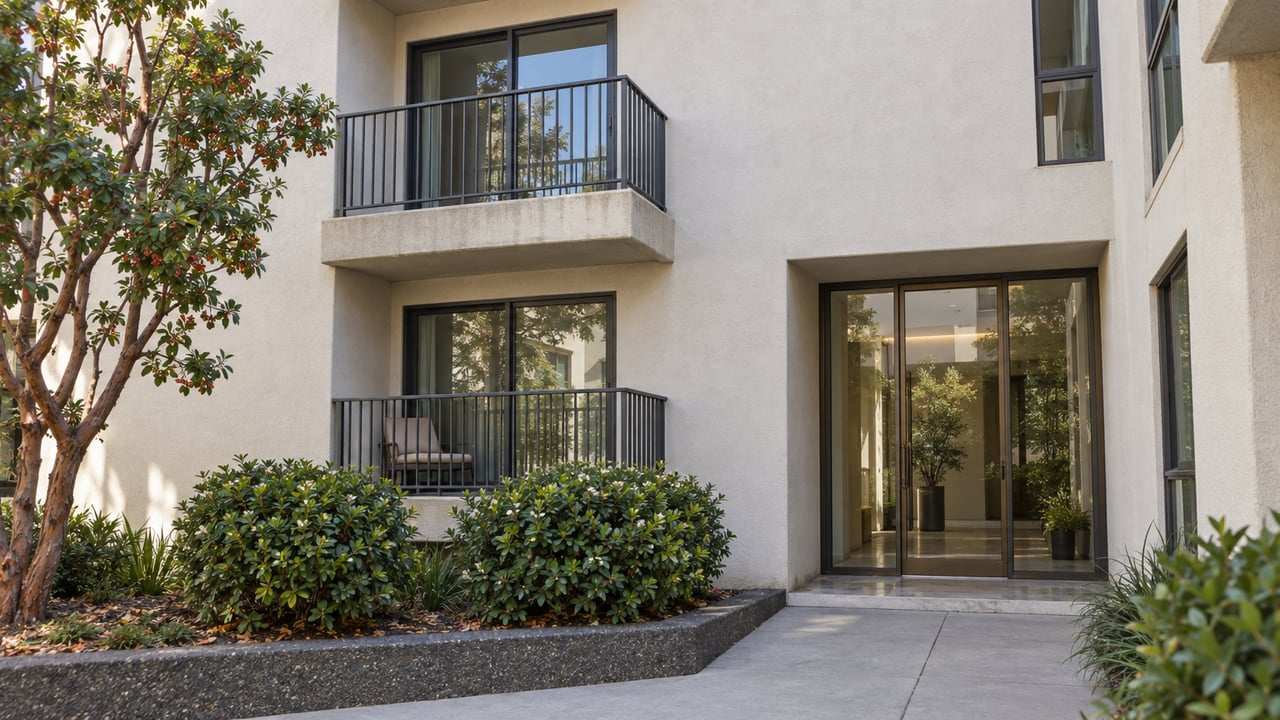
The first is structural. Bay Legal explains that Senate Bill 326 requires California condo associations with three or more units to inspect exterior elevated elements, meaning balconies, decks, stairways, and walkways built on wood framing more than six feet above the ground. The first round of inspections was due January 1, 2025, and there was no extension. That's worth pausing on, because a companion law for apartment buildings, SB 721, did get pushed back to January 1, 2026 under AB 2579. Condo associations got no such grace. Any HOA that still hasn't completed its inspection is, as of this fall, well past the deadline with the clock still running.
A newer law also affects condo resale disclosures, and an inspection gap is the kind of issue a buyer's lender will ask about directly.
The second check is financial. Fannie Mae and Freddie Mac are both raising the bar on how much of an association's budget has to go into reserves. According to Condo Control, the long-standing floor was 10 percent of budgeted assessment income. For loan applications dated on or after January 4, 2027, that floor rises to 15 percent. There's already a tightening in effect before that date arrives. Rapid Eye Inspections reports that, since August 3, 2026, lenders that rely on an association's reserve study instead of the flat percentage can no longer accept a baseline funding plan. They now have to confirm the budget matches the study's highest recommended allocation, not just some plan labeled adequate.
Insurance costs are another issue for coastal condo buildings. Coastal Orange County buildings have been trading up to higher deductibles for the past two years specifically to keep annual premiums manageable as insurers repriced California coastal risk, in some cases moving a single building's master policy from roughly $80,000 a year to more than $130,000.
What happens when a building fails one of these checks
When a lender flags a condo project, the practical effect is that conventional financing disappears for every unit in it, not just the one currently for sale. Buyers who still want in are typically looking at a 20 to 30 percent down payment instead of the 3 to 5 percent available on a warrantable unit, and a rate that starts at roughly 1.75 percentage points above the standard 30-year conventional rate. Buildings carrying that status can also see their resale values move, with research pointing to reductions in the range of 5 to 30 percent compared to similar, warrantable properties nearby.
That's the mechanism behind the Laguna Woods Village numbers. It wasn't that buyers stopped wanting units there. It's that most buyers can't write a cash offer, and the ones who can suddenly had far less competition and far more leverage.
Why this is showing up in coastal Orange County specifically
Salt air accelerates the exact kind of deterioration SB 326 inspections are designed to catch, so older buildings near the coast in cities like Newport Beach, Laguna Beach, Huntington Beach, and Dana Point are turning up more deficiencies than inland communities built the same year. When an inspection finds a problem and the reserve fund can't absorb it, the board faces a difficult funding decision.
Rising insurance costs, the new balcony inspection law, and reserve funding pressure are now consistently named among the top issues facing Orange County HOAs in 2026, and they tend to arrive together rather than one at a time.
What to ask for before you write an offer
A buyer working with an agent who understands this should be requesting a specific stack of documents before making an offer on a coastal Orange County condo, not after opening escrow.
- The current reserve study, and whether the association is funded at 70 percent or higher against it
- The most recent SB 326 inspection report, or written confirmation that one hasn't happened yet
- The special assessment history for the past several years
- The master insurance policy, including the deductible amount, not just the coverage summary
- Any Fannie Mae or Freddie Mac project approval status the HOA or management company can confirm
Having all five documents gives a buyer a useful basis for evaluating the building. If any are unavailable, a buyer can ask why and consider what that means for the purchase.
A few direct questions
Does this only apply to high-rise buildings? No. SB 326 applies to any condo association with three or more units and a shared wood-framed elevated element over six feet high, which covers a large share of Orange County's low-rise and mid-rise condo stock, not just its towers.
If the HOA already passed its SB 326 inspection, is the building automatically warrantable? Not automatically. The inspection is only one part of the review. A building can pass its balcony inspection and still face financing questions over reserve funding.
What if I'm paying cash and don't need financing at all? The building's warrantable status still affects the pool of future buyers for that unit, which affects resale value and how quickly the unit will sell whenever the current owner decides to move.
If you're comparing condos in coastal Orange County and want someone to read the reserve study and the SB 326 report with you before you write an offer, that's the kind of homework Key Connections Real Estate does with clients before any number gets negotiated. Book an appointment and bring the HOA documents with you.
This article is general information, not legal, tax or financial advice. Consult a qualified professional about your situation.